
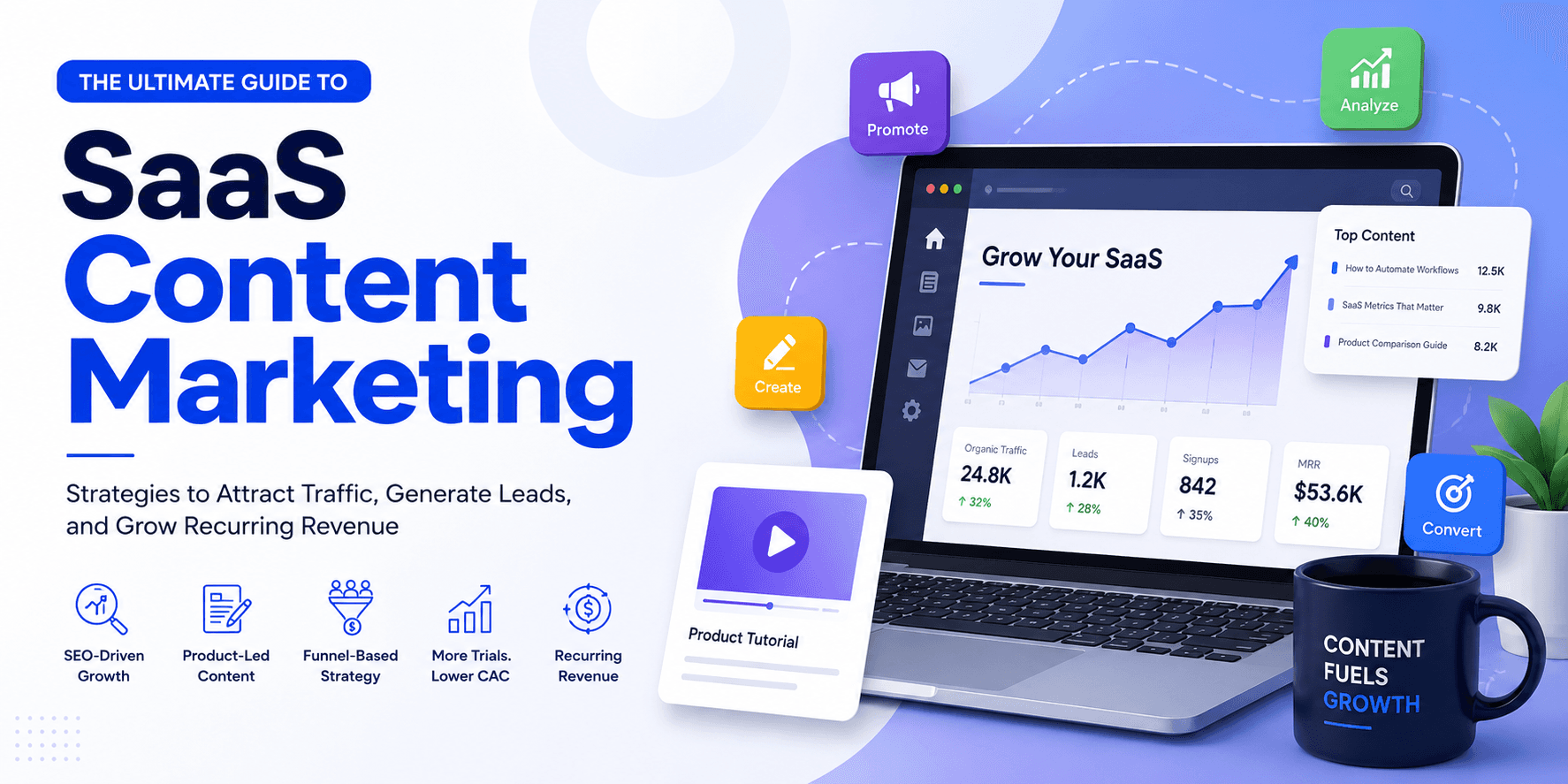
Most SaaS companies already publish blogs, post on LinkedIn, and invest in SEO. But many still struggle to turn content into qualified
signups and recurring revenue. In this guide, you’ll learn how SaaS content marketing actually works, which strategies drive conversions, and how to build a scalable inbound growth engine.
Key Takeaways
SaaS content marketing uses educational and product-focused content to attract, nurture, and convert recurring customers.
Effective SaaS content strategies align content with the buyer journey from awareness to product signup.
SEO-driven blog content compounds over time and can significantly reduce customer acquisition costs.
Product-led content, such as tutorials, integrations, and comparison pages, often converts better than generic blog posts.
Content distribution is as important as content creation for SaaS growth.
Topic clusters and funnel-based content planning improve both search visibility and conversions.
AI-search optimisation is becoming increasingly important for SaaS brands seeking visibility in AI-generated answers.
What Is SaaS Content Marketing and How Does It Work?
SaaS content marketing is the process of creating and distributing content that attracts, educates, and converts recurring software customers. Unlike traditional content marketing, SaaS content focuses heavily on education, onboarding, product workflows, and long buying cycles.
First, SaaS businesses sell subscription-based products instead of one-time purchases. That changes how content should be structured. Instead of only generating traffic, your content must also build trust, educate users, reduce friction, and increase product adoption.
For example, a project management SaaS company may publish:
“How to Manage Remote Teams”
“Asana vs Trello”
“Best Workflow Automation Tools”
Product tutorials and onboarding guides
Each piece serves a different stage of the customer journey.
Moreover, SaaS content marketing often combines:
SEO
Product-led growth
Email nurturing
Conversion optimization
Community building
AI-search optimization
According to recent industry data, 98% of SaaS companies maintain a blog as part of their growth strategy. — Source: Mailmodo, 2026 (Mailmodo)
What Makes SaaS Content Marketing Different From Traditional Marketing?
SaaS content marketing differs from traditional marketing because SaaS buyers require continuous education before subscribing.
Traditional businesses often rely on direct-response campaigns. SaaS businesses, however, depend on recurring revenue and retention. That means your content must support the full customer lifecycle.
For example:
A SaaS CRM platform may need tutorials for onboarding
An analytics tool may need comparison pages
An AI SaaS product may require workflow examples
At the same time, SaaS content usually targets:
Multiple decision-makers
Technical evaluators
Procurement teams
End users
This creates longer sales cycles and more complex content funnels.
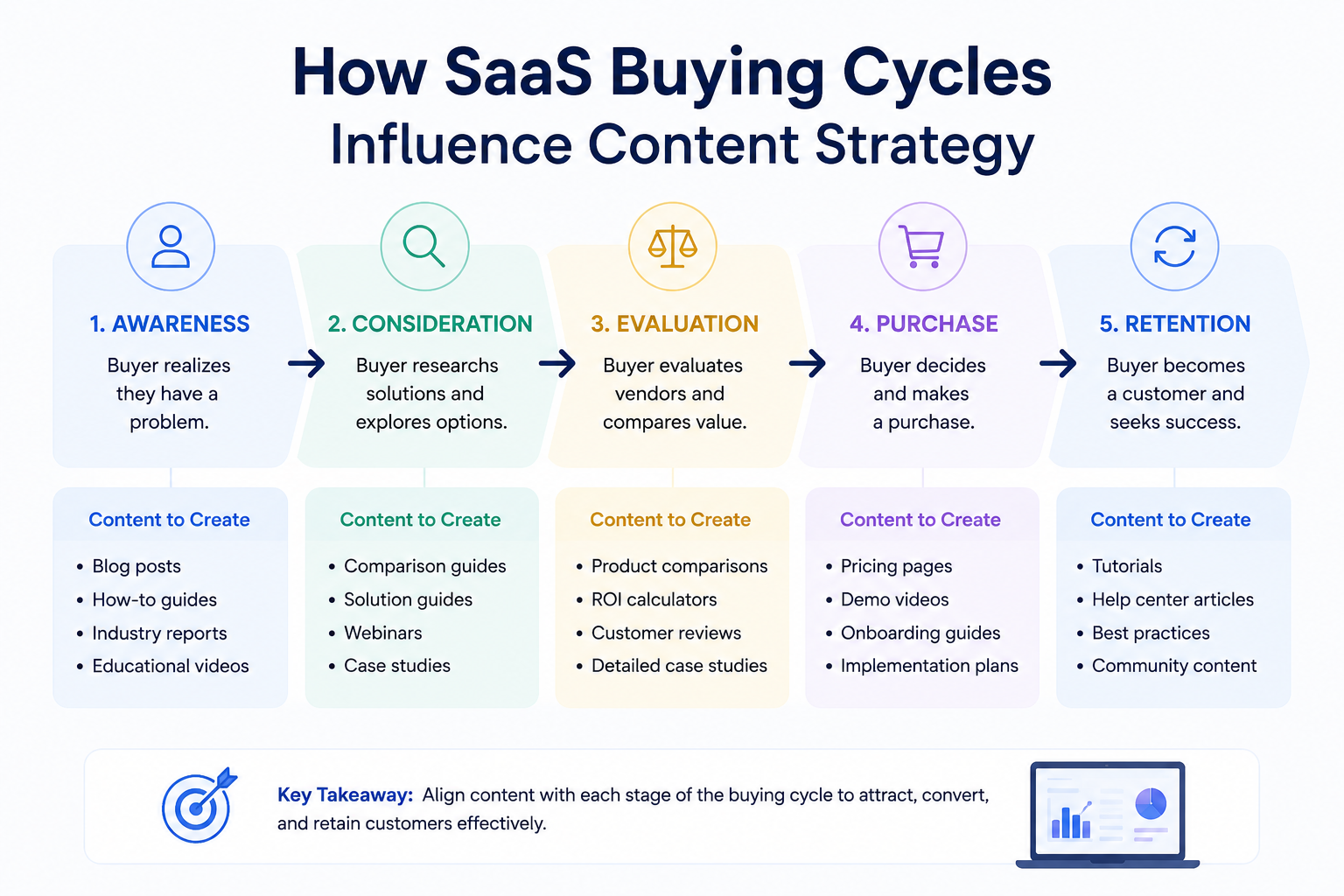
How SaaS Buying Cycles Influence Content Strategy
SaaS buying cycles influence content strategy by requiring educational, trust building, and comparison driven content across multiple stages.
Most B2B SaaS purchases are not impulsive. Buyers research extensively before committing to subscriptions.
According to industry research, 55% of hidden decision-makers consume thought leadership content during vendor evaluation. — Source: Position Digital, 2026 (Position Digital)
That means your content must answer:
What the product does
Why it matters
How it compares
Whether it integrates with existing tools
What ROI customers can expect
[Insert image: SaaS buyer journey funnel from awareness to retention | Alt text: "Understand SaaS content funnel stages for customer acquisition"]
Why Is Content Marketing Important for SaaS Companies?
Content marketing is important for SaaS companies because it generates compounding organic growth, lowers CAC, and builds long-term trust.
Unlike paid advertising, SEO-driven content continues generating traffic for years after publication.
For example, one high-ranking blog post can:
Generate thousands of monthly visitors
Drive demo signups
Build backlinks
Improve brand authority
Support AI-search visibility
According to research, B2B SaaS SEO campaigns can deliver a 702% ROI over time. — Source: Position Digital, 2026 (Position Digital)
SaaS Content Reduces Customer Acquisition Costs
SEO-driven SaaS content lowers customer acquisition costs by generating recurring inbound traffic without paying for every click.
Paid ads stop producing results the moment you stop spending. Content compounds.
For example:
A comparison article can rank for years
A template page can continuously generate leads
A tutorial can drive product-qualified traffic every month
According to DemandMetric data, content marketing costs 62% less than traditional marketing. — Source: Mailmodo, 2026 (Mailmodo)
Content Builds Trust During Long Sales Cycles
Educational SaaS content builds trust by helping users understand complex software products before purchasing.
Many SaaS tools solve technical or operational problems. Buyers want proof before committing.
That is why:
Case studies perform well
Tutorials improve conversions
Webinars increase credibility
Product walkthroughs reduce friction
According to SaaS marketing research, 49% of B2B SaaS marketers consider case studies the most effective sales content format. Source: Position Digital, 2026 (Position Digital)
AI Search Is Changing SaaS Content Marketing
AI search optimisation is becoming a core SaaS growth strategy because AI assistants increasingly summarise and recommend content directly.
Tools like ChatGPT, Perplexity, and Google AI Overviews now extract standalone answers from blogs.
That means your content should include:
Clear definitions
Self-contained paragraphs
Direct answers
Structured headings
Original insights
Data-backed statements
How Do SaaS Companies Generate Leads Through Content Marketing?
SaaS companies generate leads through content marketing by attracting high-intent visitors and converting them into trial users or demo requests.
The best SaaS content strategies align with the buying funnel.
Here’s a simplified framework:
Funnel Stage Content Type Goal TOFU Blog posts, guides, videos Generate awareness MOFU Case studies, webinars, comparisons Build trust BOFU Demo pages, integration pages, pricing content Drive conversions
TOFU Content Attracts Organic Traffic
Top-of-funnel content attracts users searching for educational information related to their problems.
For example:
“Best CRM Software”
“How to Automate Sales Workflows”
“What Is Product Analytics?”
These topics help SaaS companies capture early-stage search intent.
According to industry reports, 36% of SaaS companies say content has the biggest impact on revenue growth. — Source: Position Digital, 2026 (Position Digital)
MOFU Content Builds Consideration
Middle-of-funnel SaaS content helps buyers compare solutions and evaluate trustworthiness.
This content includes:
Case studies
Comparison pages
ROI calculators
Webinars
Customer interviews
For example, “HubSpot vs Salesforce” pages often attract highly qualified traffic because users already understand the problem.
BOFU Content Converts Visitors Into Customers
Bottom-of-funnel content converts high-intent visitors into signups through product-focused pages and CTAs.
This includes:
Integration pages
Product tutorials
Pricing explainers
Migration guides
Demo landing pages
According to SaaS research, landing pages with strong CTAs can improve conversion rates significantly. — Source: Mailmodo, 2026 (Mailmodo)
[Insert image: SaaS content funnel visualization | Alt text: "Optimize SaaS content funnel for conversions"]
What Types of Content Work Best for SaaS Products?
Product-led content, comparison pages, tutorials, and case studies are among the highest-performing SaaS content formats.
Different content types solve different growth challenges.
Product-Led Content Improves SaaS Conversions
Product-led content focuses on showing users how a SaaS product solves specific problems through tutorials, use cases, and workflows.
This content works because users can immediately visualise the product’s value.
Examples include:
Workflow tutorials
Automation guides
Integration walkthroughs
Dashboard walkthroughs
For example, a social media scheduling tool might create:
“How to Schedule Instagram Posts Automatically”
“How Agencies Manage 100+ Client Accounts”
[Internal link: "product-led growth strategies" → suggested target page/topic]
Comparison Pages Generate High-Intent Traffic
Comparison pages often generate high-conversion traffic because users searching comparison queries already have purchase intent.
Examples include:
“Notion vs ClickUp”
“Best Grammarly Alternatives”
“HubSpot vs Pipedrive”
These pages work particularly well for SaaS SEO.
Case Studies Build Authority and Trust
Case studies demonstrate real-world outcomes and help SaaS brands build credibility with buyers.
Strong case studies include:
Clear challenges
Specific workflows
Quantifiable results
Customer quotes
According to recent SaaS data, 83% of SaaS companies use challenge-solution-results structures in case studies. — Source: Digitaloft, 2026 (Digitaloft)
Video Content and Webinars Increase Engagement
Video content increases engagement by simplifying complex software concepts visually.
According to content marketing research, 83% of consumers want more video content from brands. — Source: Digitaloft, 2026 (Digitaloft)
For example:
Product demos
Feature walkthroughs
Webinars
Customer interviews
Live Q&A sessions
[Insert image: SaaS webinar dashboard or video tutorial interface | Alt text: "Create SaaS video marketing tutorials for engagement"]
How Do You Build a SaaS Content Marketing Strategy?
A SaaS content marketing strategy involves audience research, keyword mapping, funnel alignment, content creation, and distribution.
The best SaaS brands treat content like a scalable acquisition system.
Step 1: Define Your Ideal Customer Profile (ICP)
An ICP defines the type of customer most likely to benefit from your SaaS product.
First, identify:
Industry
Company size
Pain points
Job titles
Existing workflows
For example, a CRM tool targeting startups will require completely different content than enterprise-focused CRM software.
Step 2: Conduct Keyword Research for SaaS
SaaS keyword research identifies high-intent topics aligned with software buying behavior.
Focus on:
Problem-based keywords
Alternative queries
Comparison keywords
Integration keywords
Workflow searches
Examples:
“best project management software”
“Notion alternatives”
“CRM for startups”
[Internal link: "keyword research for SaaS" → suggested target page/topic]
Step 3: Build Topic Clusters
Topic clusters organize related content around central themes to improve SEO authority.
For example:
Main Topic: SaaS SEO
Subtopics:
SaaS keyword research
SaaS backlink strategies
SaaS technical SEO
SaaS content briefs
Topic clusters improve:
Internal linking
Topical authority
Crawlability
AI extraction visibility
Step 4: Map Content to the Funnel
Funnel mapping aligns content with awareness, consideration, and conversion stages.
A balanced content strategy includes:
Educational content
Commercial content
Product-focused content
Retention content
[Internal link: "content marketing funnel" → suggested target page/topic]
Step 5: Build a Distribution Engine
Content distribution amplifies reach across multiple channels beyond Google search.
Strong SaaS distribution channels include:
LinkedIn
Reddit
Newsletters
Communities
Partnerships
Founder-led content
AI-search optimization
According to recent reports, 89% of B2B marketers use LinkedIn for lead generation. — Source: Digitaloft, 2026 (Digitaloft)
[Insert image: Multi-channel SaaS content distribution workflow | Alt text: "Distribute SaaS content across SEO and social channels"]
What Is the Difference Between SaaS SEO and Traditional SEO?
SaaS SEO focuses on high-intent, conversion-driven keywords tied to software buying journeys.
Traditional SEO often prioritizes traffic volume. SaaS SEO prioritizes:
Pipeline generation
Product-qualified traffic
Commercial intent
Funnel alignment
SaaS SEO Prioritizes Intent Over Volume
High-intent SaaS keywords often outperform high-volume informational keywords in revenue generation.
For example:
“best AI CRM software” may convert better than
“what is customer relationship management”
Even with lower traffic.
SaaS SEO Requires Product Understanding
Effective SaaS SEO requires deep understanding of workflows, integrations, and customer pain points.
That is why generic AI-written content often struggles to rank long term.
According to recent data, only 4% of marketers fully trust AI-generated content without human oversight. — Source: RevenueZen, 2025 (RevenueZen)
[Internal link: "programmatic SEO examples" → suggested target page/topic]
What Are the Best SaaS Content Distribution Channels?
The best SaaS content distribution channels combine search, social, communities, email, and partnerships.
Publishing alone is no longer enough.
SEO Still Drives Compounding Growth
SEO remains one of the highest-ROI acquisition channels for SaaS companies.
Unlike social media posts, SEO content compounds over time.
According to SaaS SEO research, SEO campaigns can break even within seven months for many B2B SaaS businesses. — Source: Position Digital, 2026 (Position Digital)
LinkedIn Works Well for B2B SaaS
LinkedIn performs particularly well for SaaS distribution because decision-makers actively consume professional content there.
Founder-led LinkedIn strategies are increasingly effective for:
Brand awareness
Demand generation
Community engagement
Reddit and Communities Build Authentic Engagement
Communities help SaaS brands gather feedback, understand objections, and generate awareness organically.
However, promotional content usually fails.
Instead:
Share insights
Answer questions
Publish case studies
Participate genuinely
Email Newsletters Improve Retention
Email newsletters help SaaS brands nurture leads and increase retention through ongoing education.
Good SaaS newsletters include:
Product updates
Workflow tips
Industry insights
New integrations
Case studies
[Internal link: "content distribution strategies" → suggested target page/topic]
Which SaaS Content Marketing Metrics Should You Track?
SaaS content marketing metrics should measure traffic quality, conversions, pipeline impact, and retention.
Traffic alone is not enough.
Track:
Organic traffic
Conversion rates
Demo requests
Trial signups
CAC
LTV
Activation rates
Retention
Important SaaS Content Metrics
Metric Why It Matters Organic Traffic Measures visibility Trial Signups Tracks acquisition Demo Requests Indicates buying intent Conversion Rate Measures efficiency CAC Evaluates acquisition cost LTV Measures customer value Retention Indicates long-term success
[Insert image: SaaS analytics dashboard with traffic and conversion metrics | Alt text: "Track SaaS content marketing KPIs and conversions"]
What Are Common SaaS Content Marketing Mistakes to Avoid?
The most common SaaS content marketing mistakes include targeting low-intent traffic, ignoring distribution, and publishing without funnel alignment.
Publishing Traffic-Only Content
Traffic without conversions rarely creates sustainable SaaS growth.
Many SaaS blogs chase:
Viral topics
Broad keywords
Irrelevant traffic
Instead, prioritize:
Commercial intent
Product relevance
Workflow alignment
Ignoring Search Intent
Search intent determines whether content satisfies user expectations and ranks consistently.
For example:
“best CRM software” requires comparison-driven content
“how CRM works” requires educational content
Weak CTAs Reduce Conversions
Strong CTAs guide users toward demos, signups, or onboarding actions.
Every page should include:
Clear next steps
Product relevance
Contextual CTAs
Publishing Without Distribution
Even excellent SaaS content fails without distribution.
The best-performing SaaS brands repurpose content across:
LinkedIn
Newsletters
Communities
Video
Webinars
SaaS Content Marketing Tools and Examples
SaaS content marketing tools help teams scale SEO research, content production, analytics, and distribution.
SEO Tools
Popular SaaS SEO tools include:
Ahrefs
Semrush
Google Search Console
Surfer SEO
Use these for:
Keyword research
Competitor analysis
Technical SEO
Topic clustering
[Insert image: SEO keyword research dashboard | Alt text: "Research SaaS keywords using SEO tools"]
Analytics Tools
Analytics tools help track:
Conversion rates
Attribution
Engagement
Funnel performance
Popular options include:
GA4
Mixpanel
Hotjar
HubSpot
AI Writing and Optimization Tools
AI tools help SaaS teams:
Scale outlines
Generate drafts
Improve workflows
Optimize repurposing
However, human editing remains critical.
According to recent data, one in two writers now uses AI tools in content workflows. — Source: Digitaloft, 2026 (Digitaloft)
Real SaaS Content Marketing Examples
Strong SaaS brands often dominate through:
Comparison pages
Educational hubs
Free tools
Templates
Research reports
Examples:
HubSpot
Notion
Ahrefs
Zapier
[Internal link: "B2B content marketing examples" → suggested target page/topic]
What Should You Do Next After Reading This Guide?
The next step is building a structured SaaS content system instead of publishing random blog posts.
Start small. Stay consistent.
Run a Content Audit
A content audit identifies outdated, underperforming, or conversion-poor pages.
Review:
Traffic
Rankings
Conversions
Internal links
CTAs
Prioritize BOFU Content First
Bottom-of-funnel content often delivers faster ROI than broad educational content.
Start with:
Comparison pages
Alternatives pages
Integration pages
Workflow tutorials
Build Topic Clusters
Topic clusters improve authority and strengthen internal linking structures.
Create:
Pillar pages
Supporting articles
Related use cases
[Internal link: "SEO content brief template" → suggested target page/topic]
Set Measurable KPIs
Clear KPIs help SaaS teams measure content performance accurately.
Track:
Organic growth
Demo requests
Trial signups
Pipeline influence
Revenue attribution
Conclusion
SaaS content marketing is no longer just about publishing blogs for traffic. The best SaaS brands use content to educate buyers, build authority, reduce acquisition costs, and drive recurring revenue.
As AI search engines continue reshaping discovery, structured and trustworthy content will become even more valuable. Companies that combine SEO, product-led education, and strong distribution will gain long-term competitive advantages.
Start by building content that genuinely helps users solve problems. Then optimize, distribute, and improve consistently over time. That compounding process is what turns SaaS content into a sustainable growth engine.
Written by: Shubin — Content Writer & Application Developer with 8+ years of experience in SaaS growth, SEO content systems, and product development.
Reviewed by: Editorial Review Team — Specialists in SEO strategy, SaaS marketing, and AI-search optimization.
Disclaimer: This article was initially drafted using AI assistance. However, the content has undergone thorough revisions, editing, and fact-checking by human editors and subject matter experts to ensure accuracy.